

Area Pedonale
The Linear Extention of a Piazza

Studying abroad in Rome has given me the opportunity to walk and bike around the city, absorbing its streets and built environment. If one thing defines Italian urbanism, it’s the culture of the piazza. As a planning concept, they’re deceptively simple, just an open square, yet they function as some of the most vital and well-known spaces in any city. Piazza di Spagna draws tourists from around the world; Dam Square anchors Amsterdam; Market Square gives Pittsburgh its civic heart. Piazzas create room to appreciate great architecture, such as the Pantheon, Buckingham Palace, and Boston City Hall, and serve as gathering grounds that cities across the globe have adopted in their own forms. But Italy does something different with them.
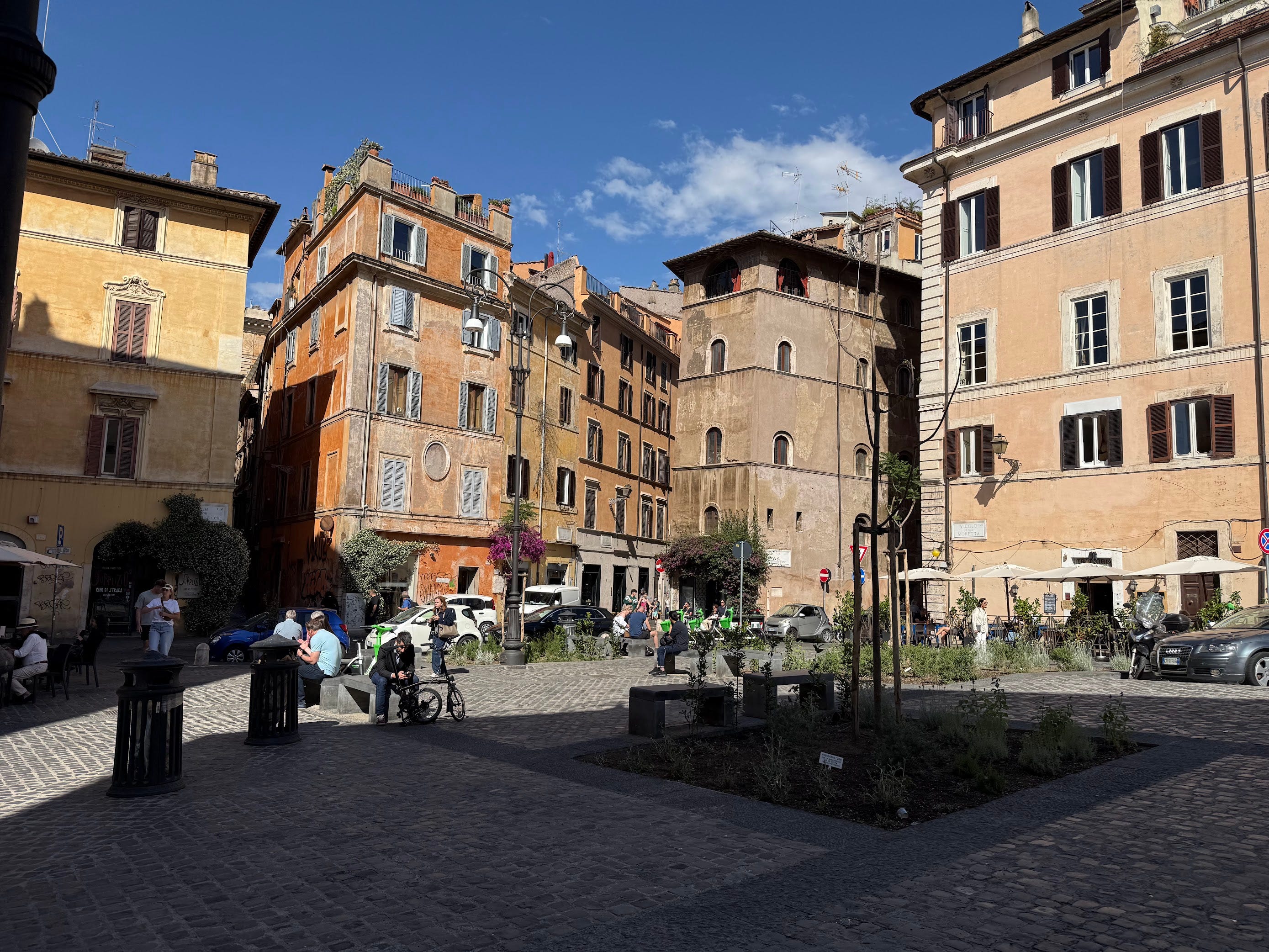
What gets lost in international comparisons is the commercial ecology surrounding the Italian piazza. Every one seems to have a bar (café), a pub, and a bakery, establishments that, by their nature, don’t assign each party a fixed territory or encourage people to stay sealed within it. Tables are small and arranged close together, naturally bleeding one party into the next. My class regularly takes over Bar Enzo for coffee, lunch, and pastries, five one- or two-tops pushed together into something communal, conversations drifting across the whole group. That kind of organic reconfiguration is nearly impossible in a typical American coffee shop, where tables are large enough to contain a group and spaced far enough apart to keep groups separate. One pub near my apartment has expanded into the adjacent parking spaces because demand from lingering customers has simply outgrown the interior. The piazza doesn’t end at the square’s edge; it spills into the businesses that ring it, and those businesses are designed, deliberately or not, to keep it spilling.
This is where many piazzas outside Italy quietly fail. As prime real estate surrounding high-footfall squares becomes increasingly valuable, luxury retailers, flagship stores, and upscale restaurants price out the kinds of businesses that actually animate a space. Dam Square in Amsterdam is a striking example: monumental in scale and unmistakably central, yet the surrounding commercial fabric offers almost no outdoor dining culture to speak of, no small tables spilling onto the stone, no reason to linger beyond the sightseeing itself. The square becomes a destination rather than a place, something to pass through and photograph rather than sit in and belong to. When the businesses that once pulled everyday people into a piazza are replaced by ones that serve tourists or those with disposable income, the square loses its social function. Fewer people come with any intention of staying, and a space that derives its value from the presence of people gradually hollows out.
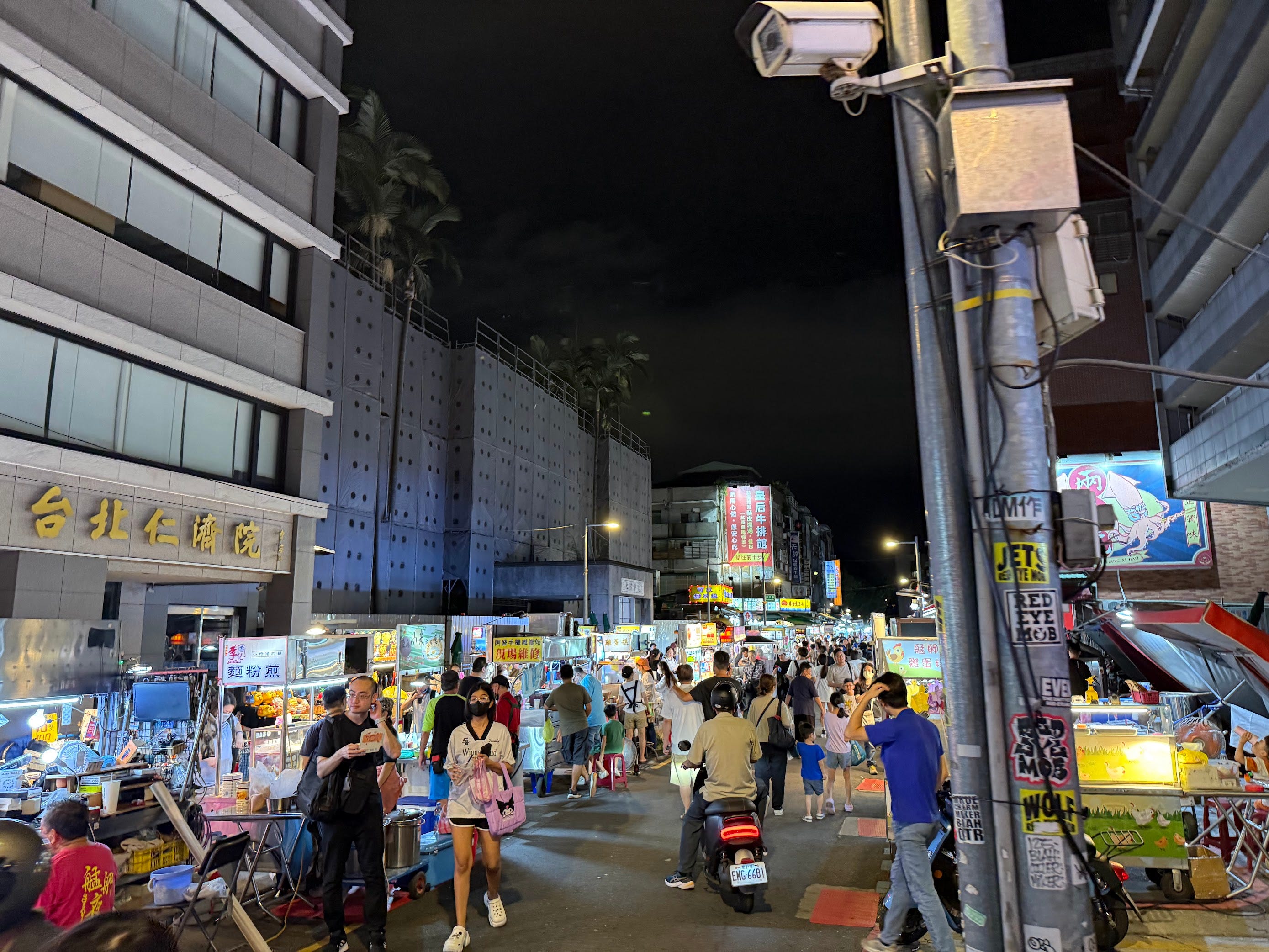
Taipei offers a partial counterpoint. Night markets and pedestrianized commercial streets, particularly in areas like Ximending, get the energy right: dense, affordable, built around food and lingering and chance encounter. But it works only within those designated corridors. Step outside them and the pedestrian logic dissolves entirely into a city overwhelmingly organized around the scooter and the car. The lesson Taipei offers is contained rather than systemic, a demonstration that the ingredients exist without a commitment to spreading them city-wide.
The other thing missing from most non-Italian versions is reach. City Hall Plaza in Boston is pleasant, but it really only functions for people who live or work nearby. The surrounding businesses spike at lunch and go quiet otherwise. In Rome, even in neighborhoods well outside the tourist core, piazzas feel consistently alive in a way I’ve rarely seen in Boston or Pittsburgh. Part of that is café culture, but a larger part is access. The ideal, someone living within a fifteen-minute walk of where they work, isn’t universally achievable given Rome’s real estate market, but enough people manage it that the same faces appear at the same establishments during the workday and after it, building genuine relationships with staff and with each other over time.
Getting to the piazza matters as much as the piazza itself. Rome, a city with remarkably few sidewalks, is nonetheless deeply pedestrian-friendly, not because of driver attitudes, which can be aggressive and chaotic in the way that Italian driving is almost culturally expected to be, but because of what the city was built for long before the car arrived. Historic and modern neighborhoods alike have cobblestone streets that slow traffic simply through their texture and scale. The streets are narrow enough and irregular enough that a car cannot physically move through them at a speed that would kill a pedestrian; the built environment enforces a kind of safety that no signage could achieve on its own. Parking exists, but it’s thin enough that walking is often genuinely faster than driving. Pharmacies, grocers, and everyday necessities are woven into the residential fabric rather than consolidated into car-dependent destinations. The result is a city that makes not driving feel natural, and as pedestrian density increases, driving becomes increasingly impractical because the infrastructure was never scaled to the car in the first place. It was built at a human scale, for human movement. The car arrived later and was never quite given permission to take over entirely.
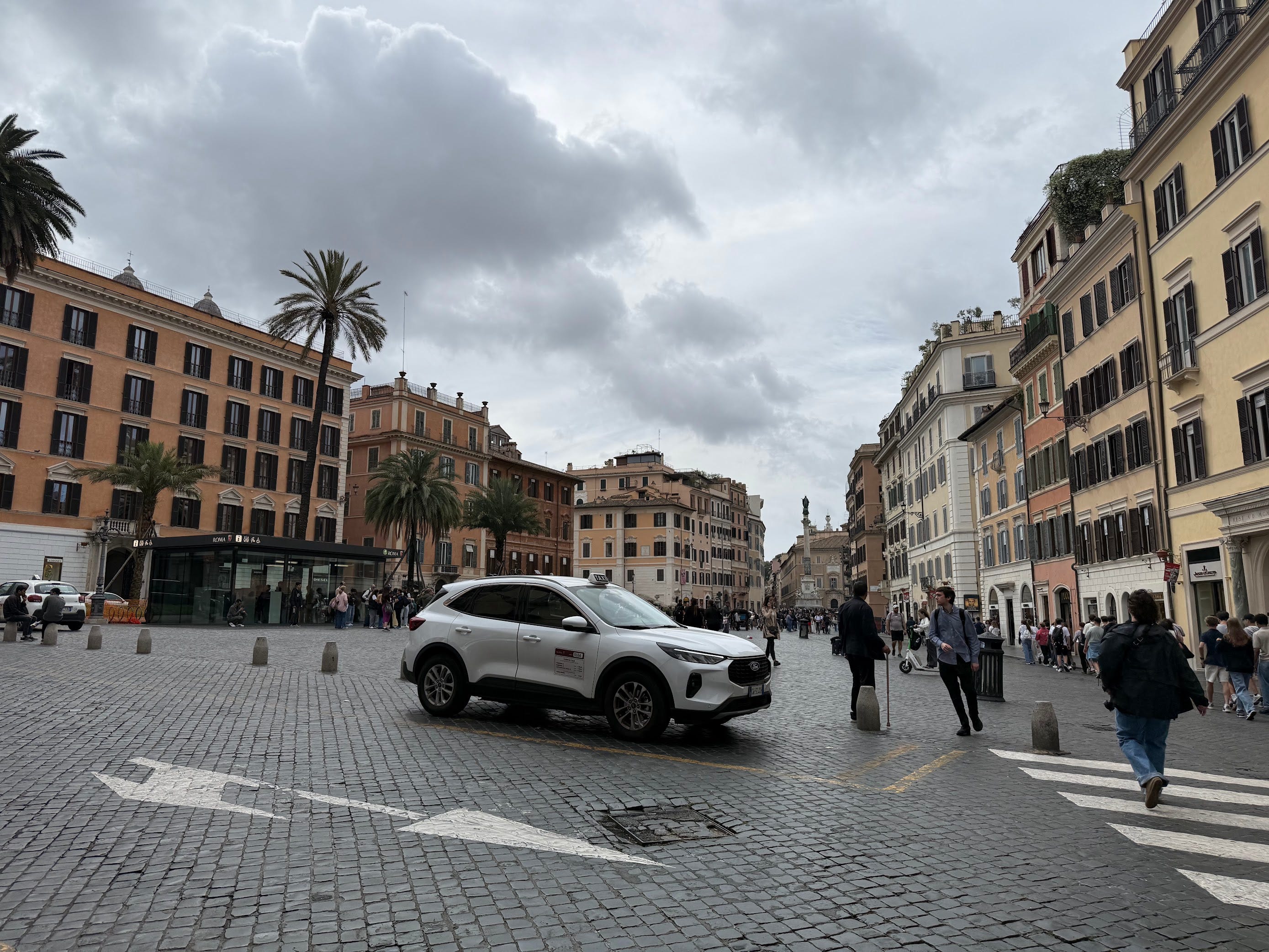
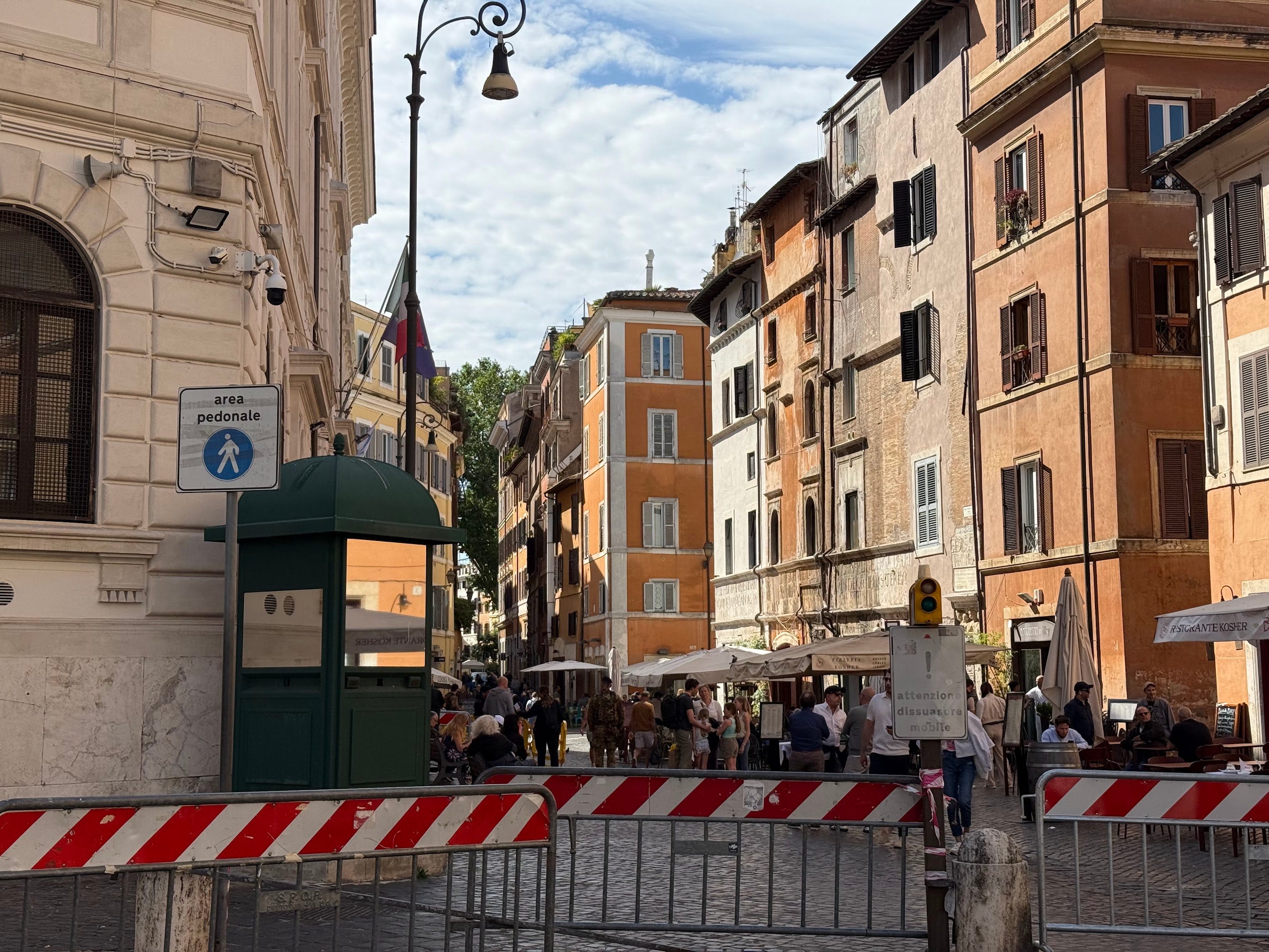
Where pedestrian density peaks, Rome formalizes the arrangement, and in doing so, extends the logic of the piazza into an entirely new form. Areas like Piazza di Spagna have been designated as Area Pedonale, translated as a pedestrian area, though that translation undersells what they actually are. These aren’t simply quiet streets or car-free corridors. They are the piazza model stretched linear, the same gravitational pull of lingering, gathering, and commercial life, unfolded along a street rather than concentrated in a square. And their influence radiates outward. The roads that feed into an Area Pedonale become quieter by consequence: less through-traffic, slower speeds, a shift in the implicit hierarchy of the street. This is what allows a road that technically still permits cars to function, in practice, much like a piazza of its own.
The street that contains Bar Enzo is exactly that kind of space. It has cars. It has outdoor dining. It has the tight geometry that forces a driver to slow, to negotiate, to acknowledge that the space belongs to more than just them, tables edging into the road, pedestrians moving without apology, the whole street operating as shared territory. Most of the time it works. Oftentimes, a driver beeps, breaking the spell and revealing the tension underneath: an urbanism built for the pedestrian, inhabited by drivers who haven’t fully accepted that arrangement. It’s a small gesture, the beep, but it marks the distance between a city that has the right bones and one that has fully absorbed what those bones are for. Some Area Pedonale are enforced through modal filters, physical infrastructure that prevents car entry while allowing emergency vehicles and delivery access directly to storefronts. Others rely on signage alone. What unites them is a governing principle: that some spaces belong to people moving slowly, on foot, at the speed of a city worth actually seeing.
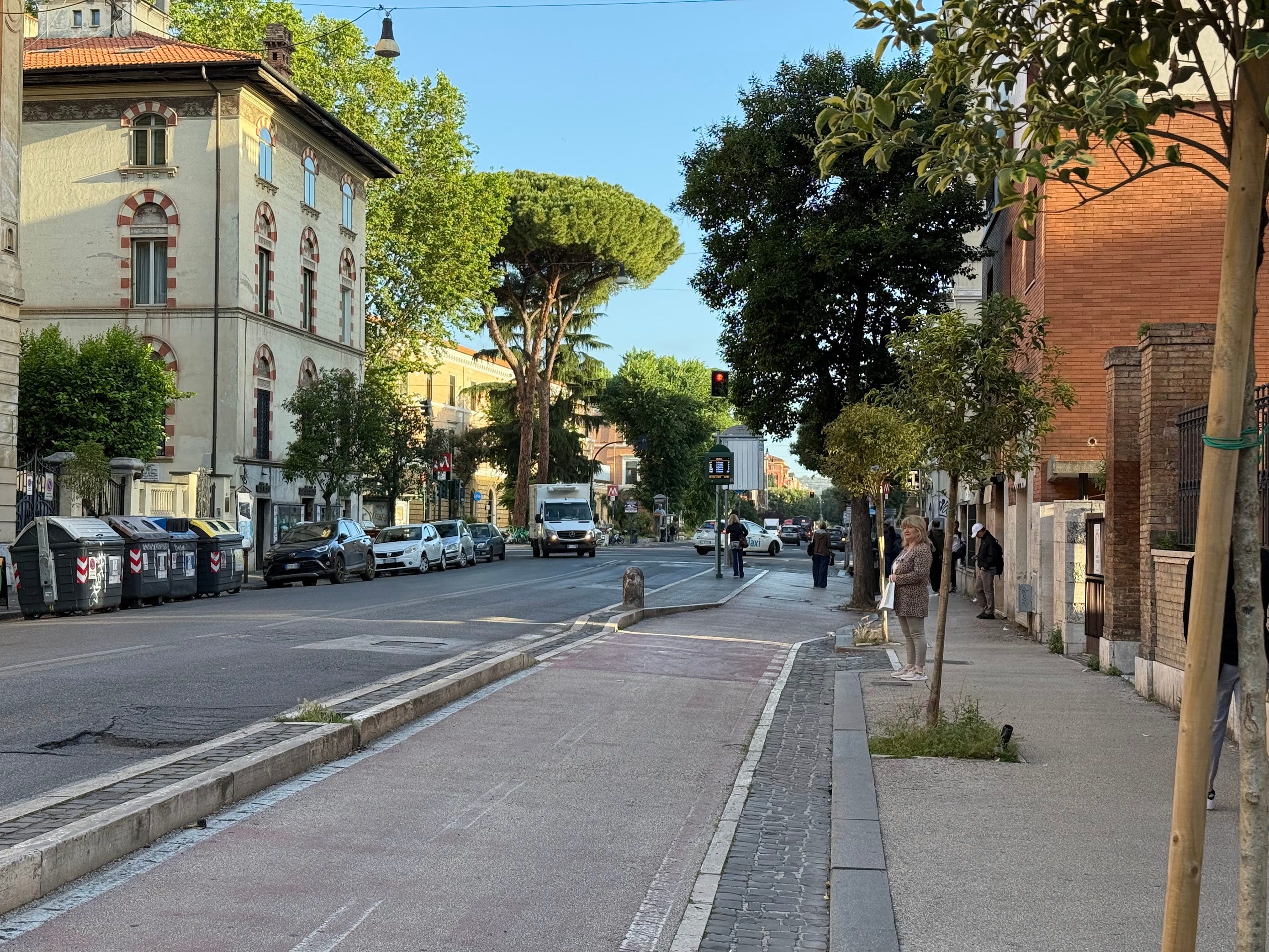
And yet Italy still has a long way to go, something that living in Prati has made difficult to ignore. Prati is a new Roman neighborhood, built on a rational grid in the late twentieth century, more ordered and legible than the tangled centro storico. It has bike lanes. It has signage. On paper, it should work. In practice, biking through Prati is significantly worse than biking through neighborhoods with none of that infrastructure. The lanes are present but the urbanism isn’t: streets are wide enough for cars to move quickly, parking is abundant, and the hierarchy of the road still clearly belongs to the vehicle. A painted lane does not make a cyclist feel safe when the street it runs along is scaled for speed. What makes cycling and walking genuinely pleasant in Rome’s older neighborhoods isn’t the signage, it’s the quiet, the narrowness, the sense that a car is a guest moving carefully through a space that was never designed with it in mind.
This is where the Netherlands has solved something that Italy hasn’t. In Dutch cities, cars behave like guests not merely because drivers are more courteous but because the infrastructure was deliberately redesigned to make them so, traffic calming, modal filters, consistent prioritization of the cyclist and pedestrian at every level of the network, not just in the scenic center. Italy has absorbed some of that vocabulary, the area pedonale, the modal filter, the occasional protected lane, but applied it selectively, often as an aesthetic gesture toward better urbanism rather than a systemic commitment to it. The result is a city of extraordinary contrasts: neighborhoods where the pedestrian reigns almost by historical accident, and others where the planning logic defaults back to something that would feel at home in an American suburb, wider and faster and more forgiving of the car. Getting the whole city to feel like its best streets is not a question of adding more lanes. It’s a question of deciding, at every scale, who the street is actually for.